courage for CAREER change
FOUR psychological tools
Dr Christian heim
Dr Caroline heim
WHO 06.11.25
ARMED-with-my-values tool
Shelving tool
Mindfulness tool
Powerwalk tool
change

Transition times - changing job, changing location, losing employment - are adverse life events.
During times of change, we can feel OFF-BALANCE. Like standing on our toes.
We become more balanced by having the COURAGE to FOCUS on what we VALUE.
We need to know our VALUES as a compass for our intended life direction
We need COURAGE to choose to move towards our intended life direction
We need to FOCUS on our values, our distance spots, to stay on track
values
Theory
You can find our posts on values HERE: what they are, and the theory behind them. To do anything, the brain has to value it.
What are values?
Values are “ambitions with a moral connotation”(1) and personal imperatives of what “ought to be.”(2) They interact with but are distinct from our personality.(3)
Our definition is:
Values are our culturally-inherited principles, refined by choice … to guide our priorities, goals, behaviours, and decisions.(4)
Values can be ideals (loyalty), legal principles (do not steal), leisure-based (have fun), socio-political (equality), workplace-based (greed is good), relational (be kind to others) and more. We naturally feel that others ‘ought’ to live by certain values, particular our own, while knowing that values vary from person to person. This leads to clashes and conflict. A list of values is endless. They are instilled into us as children by parents, teachers, collective history, culture, beliefs, the legal system, societal trends, and more. As we grow, we accept or reject our parents’ and others’ values while forming our own unique value system.
What’s the difference between goals and values?
This world emphasizes achieving goals. Make sure your goals line up with your values. Achieving goals while neglecting values can lead to depression. I’ve seen it in clinical practice: the successful businessperson who loses their family, the traveller chasing experiences but missing self-acceptance, the celebrity liked by all but close to no one.
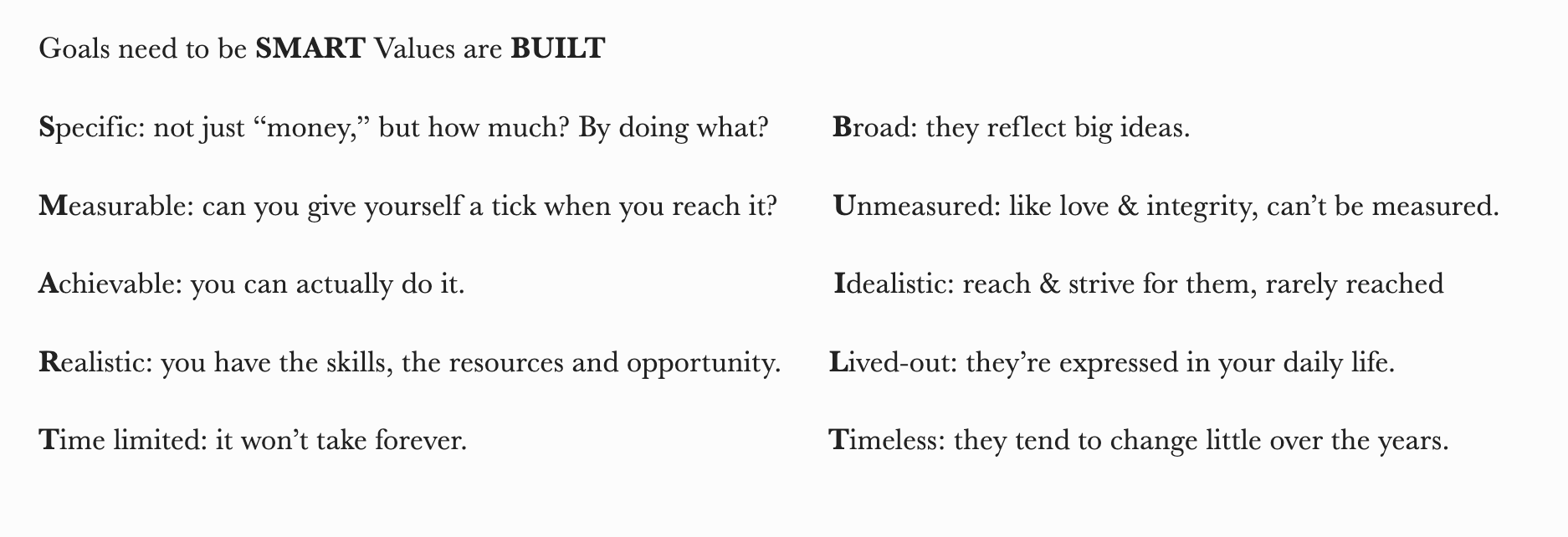
Write down your values. Build your goals on them. Let values guide what matters.
How can I know my values? Consider this tool while you sit quietly for a few hours:
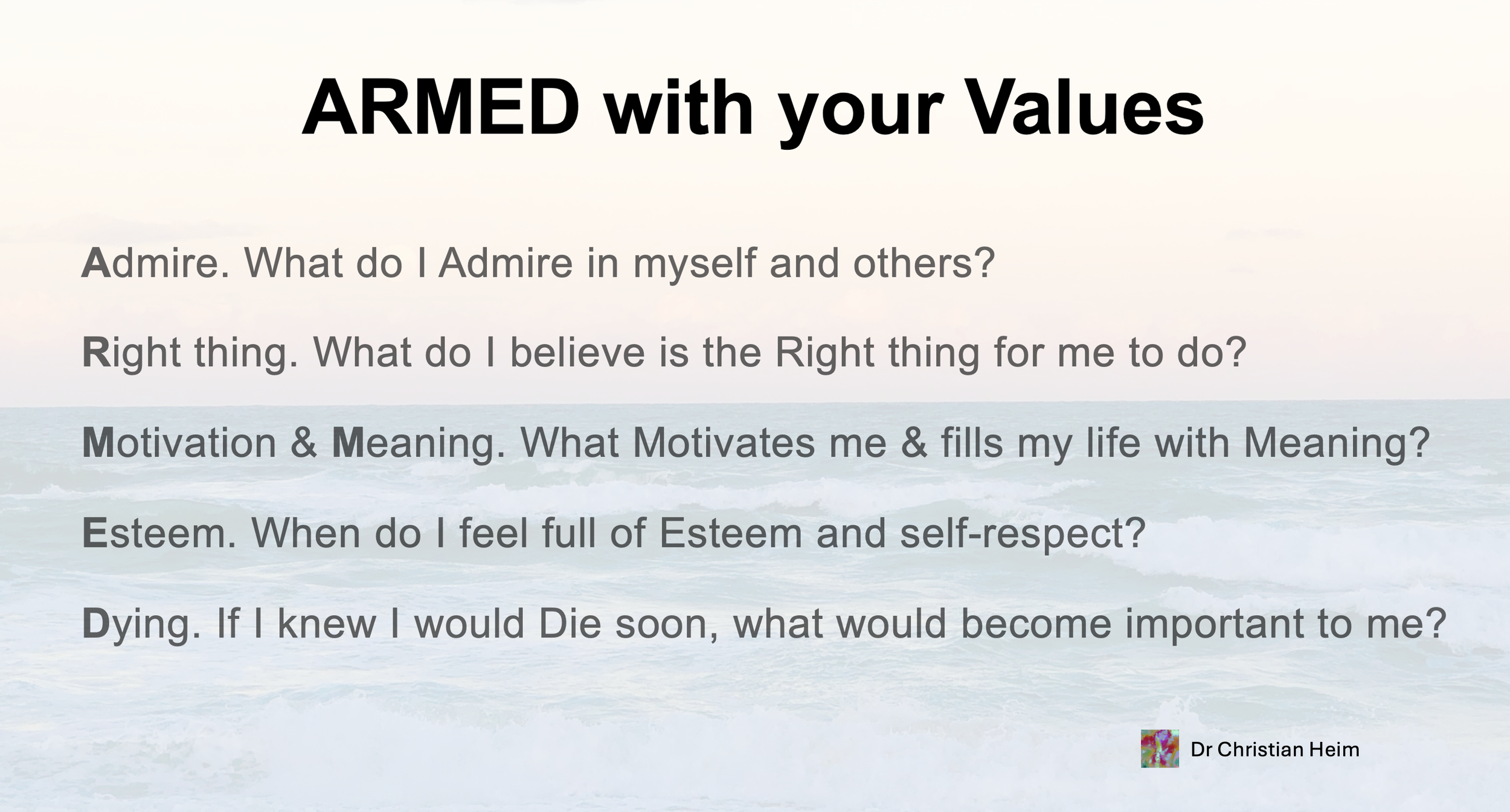
To get through times of change, make decisions in line with your values:
FOCUS on what you really VALUE
And do what you really value.
This takes COURAGE.
Courage

Why have courage?
To move towards and live out what you value and what you want.
What is courage?
While feeling fear, be aware of it and choose the action which will achieve the right outcome
Theory
You can find our POSTS on courage HERE. They deal with what courage is, and the theory behind it.
Scientists have articulated the pathways in the brain which are active while people make decisions which involve courage (See Nili et al. study). This is exciting. In the study, people were asked to pull a trolley with a live snake as close to their faces as they could. Their brains were being imaged to see what brain-parts were involved in their decision-making.
Parts of the brain involved included the Orbito-Frontal Cortex (OFC) to coordinate decision-making, the subgenual Anterior Cingulate Gyrus (sgACG) which coordinates emotions, empathy and social cues, the Amygdala which generates feelings of fear, the Frontal Lobe for awareness, memories, beliefs and values and thinking, and the right Temporal Pole (rTP) to monitor and process social and emotional information.
In sorting through the complexity, the study found that once people chose courage it was easier for them to choose courage again in the future. People who didn’t choose courage found it harder to choose again in the future. This means that courage is a skill. It can be learned and practiced. You can get better at it. This, I believe, is highly significant.
THE COURAGE TO “face” your fear
FEEL THE FEAR (use the shelving tool)
AWARENESS (use the mindful tool)
CHOOSE COURAGE (use the power-walk tool)
EMPATHY. Choose courage for the sake of other people or higher purposes. . (know your values with the ARMED-with-your-values-tool)
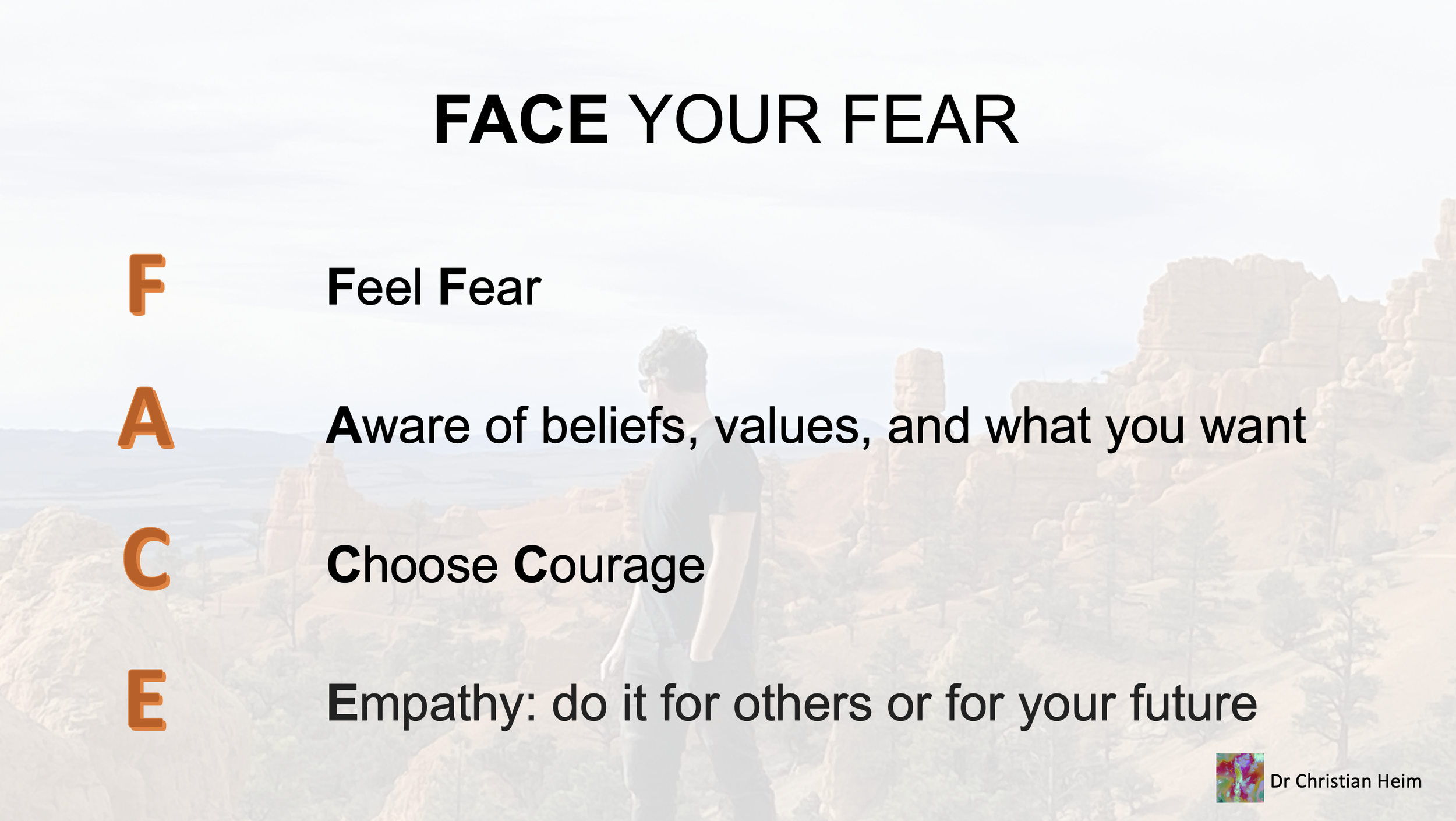
F A C E : FEEL FEAR. Feel Fear and manage it by using the SHELVING TOOL
Shelving Tool
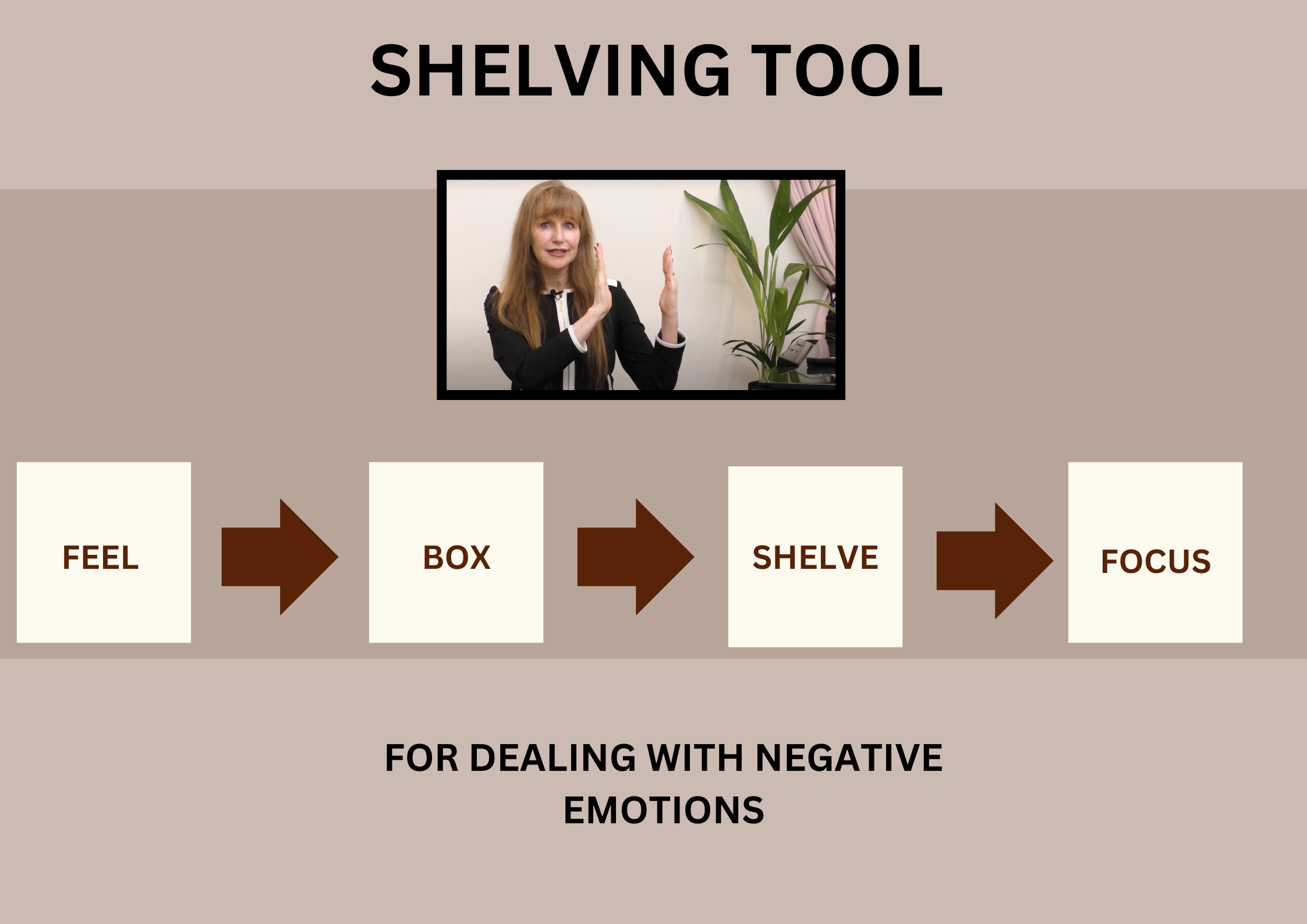
this helps DAILY
FEEL the Fear, and name it (or any other negative emotion)
BOX Picture getting the emotion out of your head and “put it” in a
SHELVE the box on an imaginary shelf over your shoulder
FOCUS on your values


THEORY
The Shelving Tool is based on the science of Exposure Therapy and Psychological Defence Mechanisms (particularly anticipation, sublimation, suppression, and altruism). It was originally published as a tool to help health-care workers combat vicarious trauma. It is currently being used for university students in a Mental Illness Prevention trial at Queensland University of Technology. Early results indicate a significant improvement in mental health outcomes when participants use the tool for 14 weeks (research is ongoing).
F A C E : AWARENESS. You create awareness in your brain by observation your own thoughts and feelings. You can be aware of your mental states by asking yourself what am I thinking and feeling right now? This, essentially, is the practice of mindfulness. In a state of awareness, you can more freely choose from a range of options which are open to you.
To help you achieve this state, here is our MINDFUL TOOL. It is an acronym for daily mindful activities.

F A C E : CHOOSE COURAGE by using the POWERWALK TOOL
POWERWALK TOOL

Powerful time —> REMEMBER
Body response? —> NOTICE IT
Powerwalk —> WITH BODY RESPONSE
Remember, Notice, Walk
The power-walk tool is based on the James-Lange Theory of emotions. Imagine you come across a bear on the forest. In this scene, your heart starts racing and you begin to run away THEN you become aware of fear in you. The point is that the body responds before we are aware of the emotion. For the power-walk, we choose to use the body response to embody a desired emotion to make it easier for you to choose courage.
REMEMBER a time when you felt Powerful
NOTICE how your body is responding now. Do you smile, bring shoulders back, stand straighter?
WALK during one chosen day-walk as a Power-walk. Bring the smile, straight stance, shoulders back or whatever else you notice into your walk and this will help create in you an emotional state more conducive to choosing courage.
F A C E : EMPATHY. Use empathy for others (I’ll make mum proud of me, provide for my family, contribute to society, I’ll help make the world a better place) as a motivation to choose courage. Philosopher David Hume articulated how strongly we are motivated by other people. His ideas have been confirmed in recent studies. Empathy helps you CHOOSE COURAGE. Empathy, for your significant others and for your future self, is a core component in our approach to Preventative Mental Health.
The ARMED-with-your-values Tool helps in this.
But how do I deal with the difficult emotions I have at the moment?
From Anger to Determination
Anger is a difficult emotion. It can be destructive. It has an energy and a quality. Express the energy safely in exercise, walking, jogging, or talking and letting off steam. Turn the quality of anger into determination for something you want. Sports people do this in soccer, rugby, wrestling and tennis. This takes practice. It also takes thinking about your feelings for a good outcome.
“I feel angry but I am determined to live by my values”
From Sadness to Reflection
Sadness is a difficult emotion. It is seen as negative and self-destructive. It has an energy and a quality. The energy is quiet and inward-looking. This can become useful reflection. Imagine you are sitting by a large window looking out at rain. You see your reflection but can also see the trees and grass beyond. It is dull and drab but can feel beautiful. Aim to look beyond your reflection towards the world beyond. There is still hope.
“I feel sad, but I can reflect on this. This too shall pass. I can see beyond it.”
COURAGE FOR CAREER CHANGE IS…

In the midst of anger or feeling overwhelmed,
Look above to FOCUS your eyes on your spot,
your VALUES, your stability,
And CHOOSE COURAGE to move forward.
Join our email list for monthly expert-backed resources on mental health, courage, and navigating life

A Small Thought, Backed by Science
One short, useful thought each week, grounded in psychological research and inspired by evidence that brief positive messages can support mental wellbeing.
Text GOOD to +61 436 967 377 to join free. Reply STOP at any time.
REFERENCES + BIBLIOGRAPHY
FOR VALUES
1.Schroeder, Doris, Kate Chatfield, Michelle Singh, Roger Chennells, and Peter Herissone-Kelly. "The four values framework: Fairness, respect, care and honesty." Equitable Research Partnerships, pp. 13-26. Springer, Cham, 2019, 13-26
2. Tsirogianni, Stavroula, and George Gaskell. "The role of plurality and context in social values." Journal for the Theory of Social Behaviour 41, no. 4, 2011: 441-465.
3. Allport, Gordon W., Philip E. Vernon, and Gardner Lindzey. Study of values. (1960). Third edition.
4. Heim, Christian, and Caroline Heim. Resilient relationships: techniques for surviving hyper-individualism, social isolation, and a mental health crisis. Routledge, 2023. Chapter 6.
FOR NEGOTIATING STRESSORS
Heim, Christian, and Caroline Heim. "How Long-Term Couples Cope with Chronic Stressors and Adverse Life Course Events in Marriage: A Qualitative Study." The American Journal of Family Therapy (2025): 1-23.
Heim, Caroline, and Christian Heim. "Jointly Negotiated Conflict Resolution Strategies of Couples in Long-Term Marriages: A Qualitative Study." Contemporary Family Therapy 47, no. 1 (2025): 16-28.
FOR COURAGE
Findyartini, Ardi, Estivana Felaza, Daniar Setyorini, and Rita Mustika. "Relationship between empathy and motivation in undergraduate medical students." GMS journal for medical education 37, no. 4 2020: Doc43.
Magnano, Paola, Anna Paolillo, Silvia Platania, and Giuseppe Santisi. "Courage as a potential mediator between personality and coping." Personality and individual differences 111, 2017: 13-18.
Nili, Uri, Hagar Goldberg, Abraham Weizman, and Yadin Dudai. "Fear thou not: activity of frontal and temporal circuits in moments of real-life courage." Neuron 66, no. 6, 2010: 949-962.
Zaki, Jamil, "Empathy: a motivated account." Psychological bulletin 140, no. 6, 2014: 1608
Zavaliy, Andrei G., and Michael Aristidou. "Courage: A modern look at an ancient virtue." Journal of Military Ethics 13, no. 2, 2014: 174-189.